The Sky We Buried
What oil actually is, and why this isn't the first time life has reshaped a planet
A gallon of gasoline contains the chemical residue of about ninety tons of prehistoric plant matter — plankton, algae, or trees that captured sunlight via photosynthesis, escaped being eaten or decomposed by sinking into anoxic muds or being trapped under sediment, and were then transformed by heat and pressure over the next tens to hundreds of millions of years into the substance someone eventually pumps into a car at the corner gas station.
The miracle of oil is not that it burns. The miracle is that it exists at all.
The chain that produced it
The process that produces oil is staggeringly inefficient.
Photosynthesis captures only about one percent of the sunlight that falls on a leaf. Nearly all of the resulting biomass is eaten, respired, or decomposed back to CO₂ within years. Only about one part in ten thousand ever escapes the recycling cycle by being buried in conditions hostile to decomposition. Only a portion of that ever gets cooked under enough heat and pressure to become hydrocarbons. Only a portion of that ever migrates into reservoirs porous enough to extract.
Multiply the losses out and you arrive at the ninety-ton figure. That is what it takes to produce a single gallon of gasoline: a small forest’s worth of sunlight that escaped being eaten, was buried at the right depth, cooked for the right duration, and then sat in geological storage for tens of millions of years.
For about four dollars at the pump, anyone can buy that small forest’s worth of buried sunlight, pulled from rock thousands of feet underground by some of the most sophisticated extraction machinery ever built. It carries an average car about twenty-five miles down the road.
How small the stockpile is
All proven fossil fuel reserves on Earth — every barrel of oil, every cubic meter of natural gas, every ton of coal — amount to roughly $10^{15}$ kilograms. Earth’s mass is $6 \times 10^{24}$ kilograms.
\[\frac{\text{fossil fuels}}{\text{Earth's mass}} \approx 10^{-10}\]One ten-billionth of the planet’s mass holds enough buried sunlight to reshape its climate.
Translated to energy: the total chemical energy in all known reserves is approximately $4 \times 10^{22}$ joules. The sun delivers roughly $1.5 \times 10^{22}$ joules to Earth’s surface every day. Burning every barrel, every lump, every cubic foot of fossil fuel humanity has ever discovered would therefore release the equivalent of three days of solar input to the planet.
Three days of sunlight, condensed over hundreds of millions of years and stored as geology, dug up and burned over the course of two centuries.
The point isn’t the magnitude. It is the concentration. Oil is the most energy-dense, portable, easily exploited substance in the known solar system. Nothing else comes close. A future civilization on this planet — if there is one — will not get to repeat this. The stockpile is a one-time inheritance.
What life made
Without life, Earth would look a lot like Venus.
Same size, similar bulk composition. Venus’s atmosphere is 96 percent carbon dioxide. Surface pressure is ninety-two times Earth’s. Surface temperature averages 465°C — hot enough to melt lead. That is, roughly, the default state of a rocky planet at Earth’s distance from the sun.
Modeling studies of an abiotic Earth — the carbonate-silicate cycle operating without biological acceleration — produce a planet with somewhere between 0.01 and 0.1 bar of atmospheric CO₂ (versus 0.0004 bar today), surface temperatures averaging 40-60°C, oceans tinted green from dissolved iron that never got oxidized out, no soil (soil is largely a biological product), and almost no carbonate rock (most limestone comes from shells).
The Earth a human eye recognizes is not a default condition. It is the cumulative output of a 3.5-billion-year carbon-sorting project run by life.
The carbon currently locked in carbonate rocks — chalk cliffs, limestone formations, coral skeletons compressed over geological time — totals around $10^{17}$ tons. The carbon in today’s atmosphere amounts to roughly $10^{12}$ tons.
\[\frac{\text{carbon in carbonate rocks}}{\text{carbon in atmosphere}} \approx 10^5\]Life has tucked away approximately one hundred thousand times the current atmospheric carbon into stone. Plus everything in oil, gas, coal, and organic-rich shales. Plus everything dissolved in the oceans.
The blue marble exists because biology spent billions of years emptying the sky into the rocks.
The reversal
In 1991, six hundred oil wellheads in Kuwait — sabotaged by retreating Iraqi forces — burned for nine months. The footage looks like science fiction. Black smoke turned day into twilight across an entire country. Lakes of unburned crude pooled across the desert, reflecting columns of fire that rose three hundred feet into the air. Camels picked their way through soot-covered sand under a sky permanently darkened by petroleum smoke. Silver-suited workers were silhouetted against walls of flame, kept alive only by continuous water spray evaporating off them like clothing made of mist.
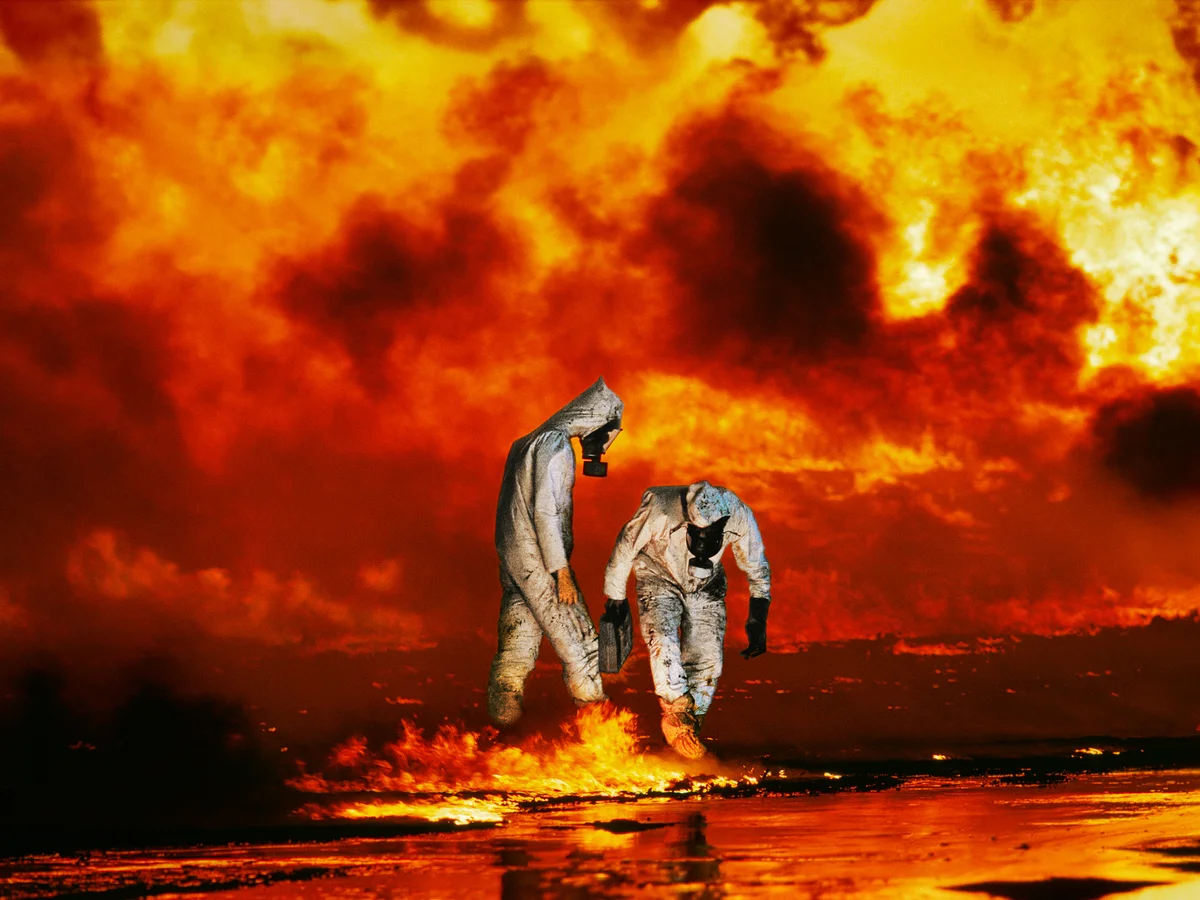
It looked like another planet. But of course it isn’t, and couldn’t be. Mars, Venus, the Moon, every other rocky world in the solar system — none of them have a single drop of oil to burn. The image of a burning oil well is one of the most apocalyptic visuals humans have ever produced, and it is also one of the most distinctively, exclusively terrestrial. The footage looks alien only because Earth is, in this respect, alien — the one known place where biology spent long enough storing buried hydrocarbons that this kind of fire is even possible.
The international response was one of the largest peacetime mobilizations in modern history: firefighting teams from 28 countries, ten thousand support personnel, $1.5 billion in costs, machinery improvised in real time. Diesel-powered bulldozers, jet-fueled cargo planes flying in firefighters from four continents, oil-revenue financing the entire effort — the largest oil-fire response in history was funded by oil, powered by oil, and waged to recover oil. Civilization could not put out the visible version of itself without going deeper into the source.
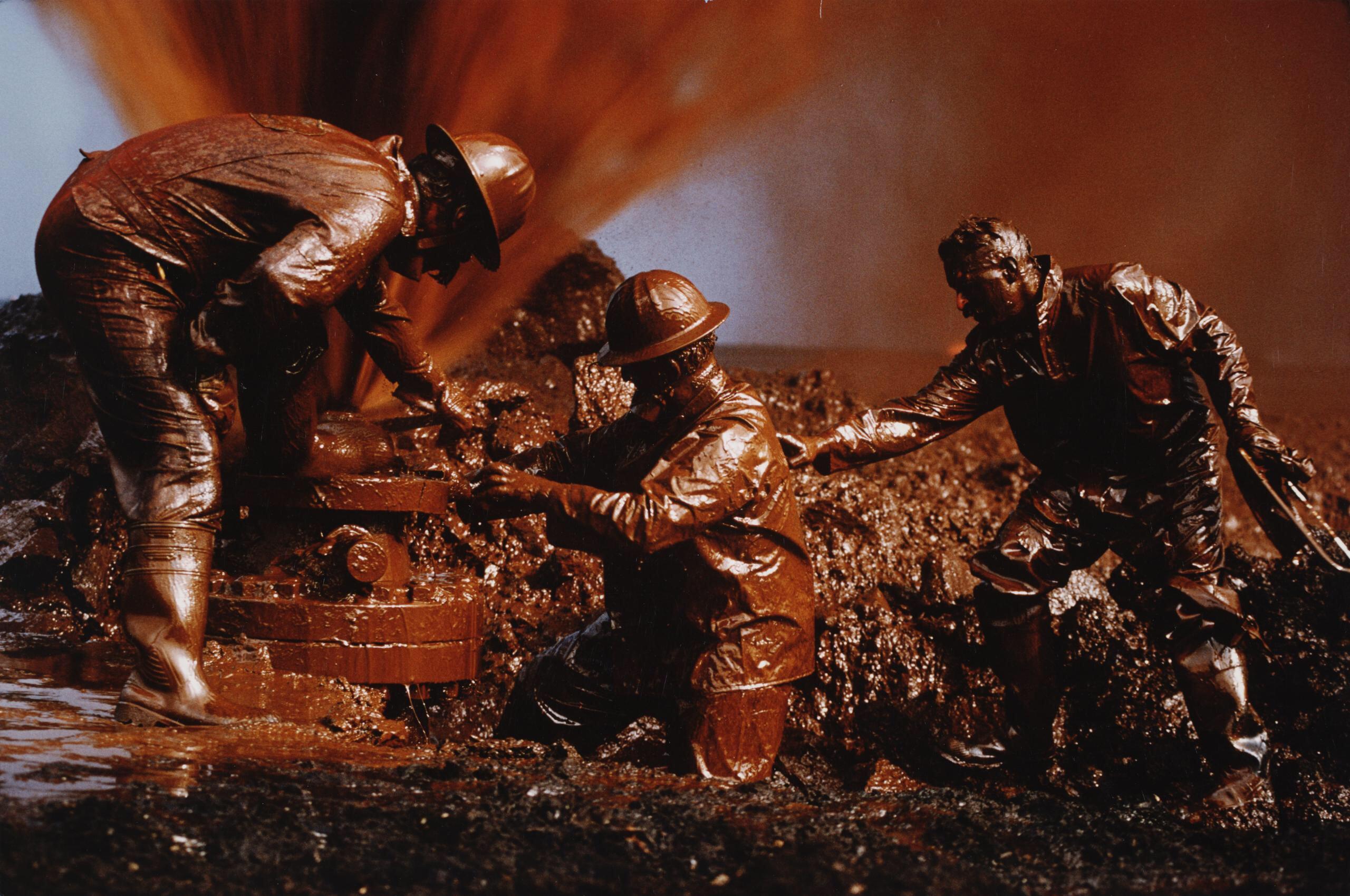
Across its ten months, the Kuwait fires released approximately 500 million tons of carbon dioxide.
Global civilization currently releases that much every five days.
Every car, every furnace, every power plant, every cargo ship, every plane — running quietly, continuously, in every country — is doing chemically what the Kuwait wellheads did visibly, just distributed across billions of small flames rather than concentrated into one hellish image. Kuwait was a once-in-a-generation environmental catastrophe that justified a 28-nation response. Civilization runs the equivalent on repeat, seventy-three times a year, without comment.
The pattern
This is not the first time a single biological discovery has rewritten Earth’s atmosphere.
Roughly 2.4 billion years ago, cyanobacteria invented oxygenic photosynthesis. It was an enormous evolutionary windfall — they could now extract energy directly from sunlight and water rather than the rare chemical compounds earlier microbes depended on. They thrived, multiplied, and pumped their waste product into the oceans and then the atmosphere.
Their waste product was oxygen. Oxygen was toxic to nearly everything alive at the time.
What followed is called the Great Oxygenation Event. Dissolved iron in the oceans rusted out and precipitated to the seafloor, forming the banded iron formations that today supply most of the world’s iron ore. The atmospheric methane greenhouse collapsed. Earth’s first known snowball glaciation followed. The result was one of the largest mass extinctions in the planet’s history. Cyanobacteria had poisoned the planet with their own success.
The pattern is recognizable. A biological discovery yields access to a concentrated energy gradient. The lineage that finds it exploits the gradient as hard as biology allows. The waste reshapes the planet faster than the system can adapt.
The fossil fuel era is running the same pattern, accelerated by a factor of millions. Cyanobacteria took hundreds of millions of years to rewrite the atmosphere. Humans are on track to do something comparable in three centuries.
Stranger still: fossil fuels exist precisely because of life’s defensive moves during the long stretch between the Great Oxygenation Event and the present. Lignin evolved so trees couldn’t be eaten. Marine plankton sank to anoxic muds where they couldn’t be decomposed. Coal seams and oil reservoirs are, in a real sense, the geological record of life trying to protect itself.
Another lifeform is now digging them up and burning them.
Oil is a substance that should not be possible to think about casually. It is the chemical residue of half a billion years of plants and plankton dying in just the right way, in just the right places, under just the right pressure — sitting in deep geological storage for tens or hundreds of millions of years, waiting.
There is no plausible future in which humans simply stop burning oil. The substance is too useful, too cheap, too embedded in everything that makes modern life function. A small forest’s worth of ancient sunlight, for four dollars at the pump, is one of the better deals available anywhere in the known solar system. Of course we will keep taking it.
But there is a wide range of how badly the experiment ends. The total reserves represent only three days of solar input — not enough fuel to fully Venus-ify the planet. Earth will not become a 465°C molten hellscape. What it can become, with much less effort, is a place where the carbon balance that biology spent billions of years building no longer functions the way it did. The atmospheric composition that made the planet livable is not a permanent feature. It was an output. It can stop being one.
We dug up the carbon that life had carefully buried, in order to drive to work faster.
The planet that emerges is the one we get.
The 1992 IMAX documentary Fires of Kuwait is worth watching. The footage does things words can’t.